 Vietnam's cruise ports, measured from the gangway
Understand the ship
Reading a deck plan, one layer at a time
A deck plan is a map of the ship drawn from above, one deck at a time. Read it the right way and it tells you what will be above your bed at midnight, how far you will walk to dinner and where you will queue for a tender.
Orientation first
Most deck plans are drawn with the bow, the front of the ship, at one end and the stern at the other, and with every deck stacked in the same orientation so that a cabin on one deck lines up with what is above and below it. Find the bow on the plan before anything else; the shape usually narrows to a point there.
The symbols you will meet
| Symbol on most plans | Meaning | Why it matters |
|---|---|---|
| Coloured blocks with numbers | Cabins, colour-coded by grade | The colour tells you the grade; the number is the cabin |
| Two small circles or a sofa icon | Beds that convert, or a sofa bed | Tells you whether a third person fits |
| A wheelchair symbol | An accessible cabin | Few per ship; book early |
| A double arrow between cabins | A connecting door | Useful for families; can carry sound for others |
| Small shapes along the outer edge | Lifeboats or tenders | Cabins behind them may have an obstructed view |
| Unlabelled grey areas | Crew or service spaces | Possible noise and early-morning activity |
Every line uses its own key, printed in a corner of the plan. Read the key before trusting any symbol from memory.
Look above and below, not just around
The most useful habit is to check the decks above and below a cabin. A quiet corridor can sit under a pool deck where loungers are dragged at dawn, under a buffet with early deliveries, or under a theatre or nightclub. Below a cabin may be a lounge with live music. Cabins with cabins above and below them, on both sides, are usually the quietest.
Do the same along the corridor. A cabin opposite a service door or next to a laundry room or crew stairs can be busy early and late. A cabin at the end of a long corridor is quiet but can be a long walk from the lifts.
Motion and the shape of the hull
A ship pitches around a point roughly in the middle and rolls around its centre line. Cabins low down and near the middle move the least. Forward cabins, especially high ones, feel the bow rise and fall most. Aft cabins can feel vibration from the propellers and engines, though many ships are designed to reduce it.
On a voyage along the Vietnamese coast, most days are port days and the ship moves mainly at night. If you are prone to seasickness, choose a low, midship cabin anyway: a rough night in the open sea between ports affects the next shore day too.
Where the tender platform and the gangway are
Deck plans also show the decks where passengers leave the ship. Gangways and tender platforms are usually on low decks, close to the waterline, often reached from a single lobby or a set of lifts. At a tender port, the queue tends to form in a lounge or theatre on a nearby deck, where tender tickets are issued.
If your voyage includes calls where the ship anchors, a cabin near the lifts that serve the tender deck saves a walk at the start and end of the day. Ask the line which deck is used for tenders; it is not necessarily marked on the public plan.
Open decks for arrivals and sail-aways
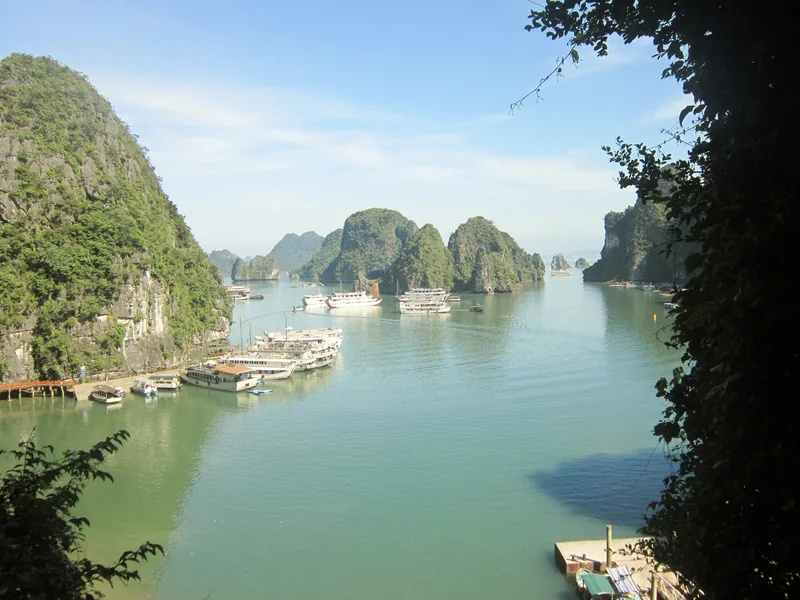
The deck plan also shows the open decks, which matter more on this coast than on many others. Arrivals among the islands of Ha Long Bay, the approach to Chan May under the hills, and the coast around Da Nang are seen most fully from a deck with a view forward and to both sides, not from a single balcony.
Look for decks marked as open or promenade areas near the bow, and for an outside walkway that runs the length of the ship. Some forward areas are closed while the ship manoeuvres in port, so the daily programme, not the plan, tells you what is open on the morning. A smaller ship that sails up the Saigon River to the city dock passes close to the banks, and an open deck low on the side gives the closest view.
A five-minute check of any cabin
- 01
Find the bow
Orient the plan so you know which way the ship faces.
- 02
Check the key
Read the line's symbols for that ship, not a different ship's plan.
- 03
Look above
Find the same position on the deck above: pool, buffet, theatre or cabins.
- 04
Look below
Do the same on the deck below.
- 05
Look around
Lifts, stairs, service doors, connecting doors and lifeboats outside the window.
The cabin grades page explains what the colours and grade codes usually mean in terms of price and inclusions.
Common questions
Questions readers ask
Which side of the ship is port?
The left side when you face the bow, the front of the ship. Starboard is the right side.
Why are cabins behind lifeboats cheaper?
The lifeboats or tenders block part of the view. Those cabins are sold as obstructed or partial view grades.
How do I know if a cabin will be noisy?
Check what is directly above and below on the deck plan, and what is beside it in the corridor. Cabins with cabins on every side are usually the quietest.
Related
Read next
Understand the ship
Cabin grades
Inside, ocean view, balcony and suite cabins explained, with guarantee fares, obstructed views and location.

Understand the cruise
Missed ports
Why cruise calls in Vietnam are cancelled or shortened, how tendering works, and what your contract says.
Understand the shore day
Shore time
How to turn hours in port into real time at a sight, with worked examples for every Vietnamese port.
Understand the cruise
Cruise season
When ocean cruise ships call in Vietnam, the itinerary patterns, and the storm months that change calls.
Independent guide for cruise passengers
Home
Start here: port-by-port distances, shore-day maths, visas for cruise passengers and plain cabin explanations.
Start planning
Send a correction or a question
Tell us which page you mean, what you found instead and when. A link to the source, or the details of your own call, helps us check it.