 Vietnam's cruise ports, measured from the gangway
Understand the cruise
Tenders, storms and the port you did not see
Cruise itineraries change. A tender port becomes unsafe in a swell, a storm closes a bay, or a ship arrives late and cuts the call short. This page explains how that works in Vietnam, which ports and months carry the most risk, and what to check in your contract.
Berth or tender: how you get ashore
At a berth, the ship ties up and a gangway goes down. At an anchorage, the ship stays offshore and tender boats, often its own lifeboats, carry passengers to a landing stage. Tendering takes longer in each direction, needs calm enough water to step between the ship and a moving boat, and stops when the sea or wind rises.
| Port | What we found | What to assume |
|---|---|---|
| Ha Long | A purpose-built cruise port with four wharves at Bai Chay | A berth is possible; anchoring in the bay also happens |
| Chan May | A 480 m wharf taking large cruise ships | Usually a berth |
| Tien Sa | A quay port in Da Nang | Check your line's port notes |
| Nha Trang and Cam Ranh | Itineraries use both names | Check whether you berth or anchor |
| Phu My | Commercial terminals with no passenger facilities | A berth |
| Phu Quoc | Could not confirm from an official source | Plan for a tender |
Sources: Viet Nam News — Sun Group opens new cruise port (3 May 2019); Vietnam Drive — Chan May cruise port (transfer company page); Cruise Critic — Ho Chi Minh City cruise port guide (cruise review site) · last checked .
Why calls are cancelled or shortened
- Weather at sea. Tropical cyclones affect Vietnam's eastern coast, normally from May to November. The tourism authority says tropical storms can cancel cruises on Ha Long Bay in summer, and that the stormy season at Phu Quoc, July to September, can disrupt ferries.
- Swell at a tender port. A ship can reach an anchorage safely and still be unable to run tenders.
- Floods on shore. In central Vietnam, October and November floods can block roads through landslides, which can empty a port day of its purpose even if the ship berths.
- Late running. A ship delayed by weather on the previous leg may arrive hours late and keep its departure time to protect the next port.
- Port decisions. Since 1 October 2026, the port border police can inspect ships and refuse permission to board or leave in defined cases, under the port security decree.
Sources: UK Foreign Office — Vietnam safety and security; Vietnam National Authority of Tourism — weather and climate; Decree 289/2026/ND-CP on security and order at port border gates — LuatVietnam English text · last checked .
What your contract usually says
Cruise ticket contracts give the line wide discretion to change an itinerary for safety, weather or operational reasons. What you get back when a port is missed is set by the contract, not by goodwill. Read three clauses before you sail: itinerary changes, refunds, and missed embarkation or late return.
As an example of how strict the language can be, the ticket contract of one large cruise line, which we read for this page, states that the cruise price is earned when paid and non-refundable except as described for the voyage, that no refunds are made for no-shows or partly used tickets, and that a guest who fails to board is not entitled to a refund or compensation of any kind. Other lines word these points differently.
Port charges and taxes are a separate question. Some contracts treat them as charges that are only incurred if the ship actually calls; others do not. Look for the words "port charges", "government taxes" and "itinerary" in the contract, and ask the line in writing if they are unclear.
Sources: Carnival Cruise Line — cruise ticket contract (cruise line contract) · last checked .
Shore plans when the ship's day changes
A ship's own excursion that cannot run because the port is cancelled is normally refunded to the shipboard account; check your line's terms. An independent booking with a local company is a separate contract. Before you pay a deposit, ask what happens if the ship does not call, arrives late or cannot tender, and get the answer in writing.
If a call is shortened rather than cancelled, redo the shore-time sum with the new times. A plan that fitted a nine-hour call rarely fits six hours: Hue from Chan May, Hoi An from Chan May and Ho Chi Minh City from Phu My are the first plans to drop.
Travel insurance policies may include cover for missed port departures, itinerary changes or cabin confinement, and may exclude known weather events. Read the policy wording for cruise sections specifically.
Where and when the risk is highest
| Port | Higher-risk months | Main reason |
|---|---|---|
| Ha Long | June to August, and storm warnings in autumn | Tropical storms; boats stopped in the bay |
| Chan May and Tien Sa | October and November | Heavy rain, floods and landslides on shore |
| Nha Trang and Cam Ranh | September to December | Monsoon rain and rougher sea for tenders and island boats |
| Phu My | May to November afternoons | Downpours slowing the road back |
| Phu Quoc | July to September | Stormy sea; tenders and boats stopped |
A cancelled port is usually replaced by a sea day or, sometimes, another port. Ships rarely make up the time elsewhere in Vietnam, because the berths are booked in advance.
Sources: Vietnam National Authority of Tourism — weather and climate; UK Foreign Office — Vietnam safety and security · last checked .
On a tender day
- Collect tender tickets as soon as the ship announces them; queues form quickly.
- Wear shoes with grip and keep both hands free when stepping across.
- Note the time of the last tender back, which is earlier than all-aboard.
- If the sea rises during the day, the ship can bring the last tender forward. Stay within reach of the pier.
Common questions
Questions readers ask
Will I get money back if my ship misses a port in Vietnam?
It depends on your contract. Lines generally reserve the right to change itineraries; look at the clauses on itinerary changes, refunds and port charges, and ask the line in writing.
Which Vietnamese ports are most likely to be cancelled?
Tender calls in rough weather, such as Phu Quoc between July and September, and Ha Long during summer storms, carry the highest risk.
What happens if tenders stop while I am ashore?
The ship decides when the last tender runs and announces changes. Stay close to the pier when the sea is rising and keep the ship's contact number with you.
Is a shortened call worth going ashore for?
Usually yes, if you shrink the plan. Redo the shore-time sum with the new times and choose something close to the port.
Related
Read next

Understand the shore day
Shore time
How to turn hours in port into real time at a sight, with worked examples for every Vietnamese port.
Understand the cruise
Cruise season
When ocean cruise ships call in Vietnam, the itinerary patterns, and the storm months that change calls.
Ports
Ports
All six Vietnamese cruise ports in one table: road distances, planning times and what fits in a call.

Ports · An Giang
Phu Quoc
Phu Quoc cruise calls: tender or berth, distances from An Thoi to Sao Beach, Duong Dong and Grand World.
Ports · Quang Ninh
Ha Long (Cai Lan)
Ha Long cruise port: berth facts, road distances, bay boats from the terminal and the Hanoi arithmetic.
Understand the ship
Cabin grades
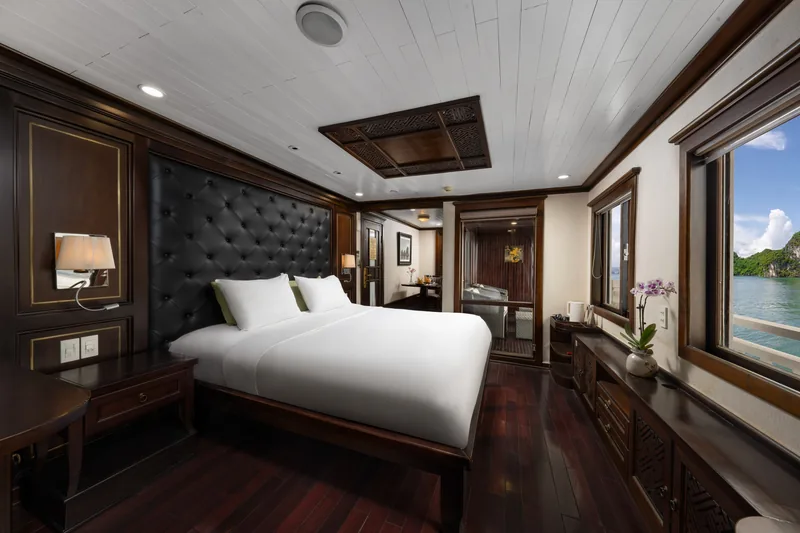
Inside, ocean view, balcony and suite cabins explained, with guarantee fares, obstructed views and location.
Start planning
Send a correction or a question
Tell us which page you mean, what you found instead and when. A link to the source, or the details of your own call, helps us check it.